
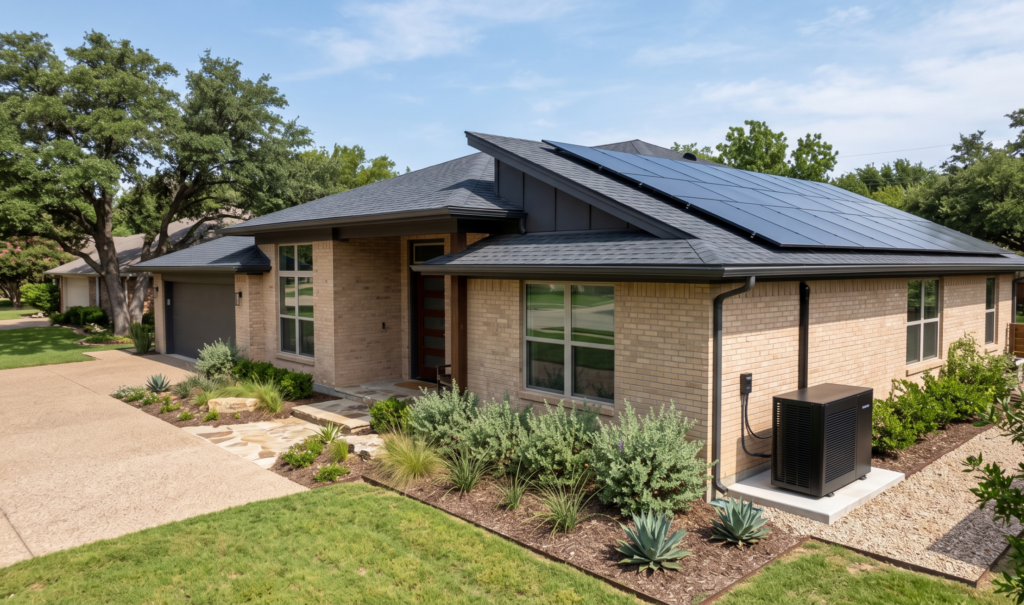
Your July electric bill just hit $580, and the shock is enough to make you look seriously at a solar installation in Texas. It is a logical move for a homeowner in Plano or Frisco who wants to escape the rising costs of the utility grid. However, if your home relies on an air conditioning unit that is over a decade old, rushing straight into a solar contract is a critical financial mistake. Most solar reps will eagerly look at your historical bills and sell you a massive, expensive system designed to generate enough raw power to feed that old AC. This approach is the equivalent of buying a larger, high-capacity water faucet to keep a leaky bucket full, rather than simply patching the hole in the bucket.
The smarter, more lucrative path is a strategy called energy downsizing. In the world of home infrastructure, saving a watt through efficiency is always cheaper than generating a watt through hardware. If your home’s air conditioner is inefficient, you will pay for an oversized solar system you didn’t need. Replacing an aging, single-stage cooling system with modern, high-efficiency heat pumps before you purchase solar panels shrinks your home’s baseline power consumption. By attacking the waste first, you dramatically reduce the number of solar panels required to run your home, saving thousands of dollars in upfront equipment costs while creating a vastly more reliable, integrated energy ecosystem.
How Your AC Unit Dictates Your Solar System Size | The Baseline Mistake
Why Does Cooling Dominate The Solar Sizing Equation In Texas?
During a brutal North Texas summer, keeping your home liveable requires an immense amount of electrical energy. Air conditioning is not just a minor line item on your power bill; it accounts for over half of a typical household’s total annual energy consumption, spiking up to 70% during peak triple-digit months. Because cooling represents the absolute peak of your electrical load, it becomes the primary factor that dictates the physical size and cost of any future solar infrastructure you put on your roof.
How Do Solar Designers Utilize Historical Bills To Determine Panel Counts?
When a solar professional evaluates your property, they look at your past 12 months of utility statements to map your total kilowatt-hour (kWh) consumption. They calculate the total volume of electricity your home consumed across the entire year to build a system that offsets that specific volume. If your home used 18,000 kWh last year—largely because an old, fading 5-ton AC unit was running around the clock—the designer will calculate a panel count specifically sized to hit that high 18,000 kWh target. They treat your historical waste as an unchangeable law of your home, completely locking you into an oversized system.
Why Does An Old Compressor Force You To Buy Extra Hardware?
An air conditioner that is over 10 years old has inevitably lost its operational efficiency. A legacy single-stage compressor draws massive amounts of electricity to deliver a fraction of the cooling power of a modern machine. If you attempt to power this fading compressor with solar energy, you are forced to purchase an extra 5 to 10 solar panels just to compensate for the mechanical inefficiency of the AC unit. At a time when residential solar hardware requires significant structural real estate and financial capital, spending thousands of extra dollars on panels just to feed a dying appliance is financial sabotage.
The Math Of The Downsizing Strategy | Cutting Upfront Capital
Why Do High-Efficiency Heat Pumps Cost Less Than Extra Solar Hardware?
When you look at the raw economics of home energy, investing in a new climate system yields a far higher return per dollar spent than adding redundant solar panels. Buying additional solar infrastructure requires paying for more panels, extra microinverters, complex roof racking, and extended installation labor. Modern high-efficiency heat pumps, by contrast, drop your household electricity demands by up to 30% the moment they are turned on. Because reducing your energy load prevents you from buying that extra solar hardware, the efficiency upgrade effectively pays for a substantial portion of its own installation costs by shrinking your solar invoice.
What Does A Downsized Project Blueprint Look Like in DFW?
To visualize the financial impact of this strategy, look at how a typical property configuration shifts when you prioritize efficiency first:
| System Parameter | Phase 1: Solar Only (With Old AC) | Phase 2: Downsized Solar (With New Heat Pump) |
| Required Annual Energy Offset | 18,000 kWh Baseline | 12,600 kWh Baseline (30% HVAC reduction) |
| Solar Panel Count Needed | 32 Premium Roof Panels | 22 Premium Roof Panels |
| HVAC Technology Type | Legacy 10-Year-Old Single-Stage | Variable-Speed Inverter Heat Pump |
| Roof Real Estate Footprint | Extremely Large (Covers most faces) | Highly Optimized (Leaves space for expansions) |
By dropping the home’s cooling demand first, the homeowner slashes 10 full panels off the required solar array size while securing a brand-new, premium heating and cooling system for the property.
How Does A Lower Power Demand Shrink Your Physical Infrastructure Costs?
Dropping your total household peak electrical demand does more than just reduce the number of panels on your roof. A downsized system reduces the complexity of your entire electrical layout. It means your system requires less thick copper wiring, smaller combiner boxes, and a lower workload on your solar inverters. It also prevents your solar array from consuming every single square foot of your roof, leaving valuable space open if you ever choose to expand your clean energy setup in the future to power an electric vehicle or a new home workshop.
Why Variable Speed Technology Changes The Solar Equation | Mechanical Synergy
How Do Variable Speed HVAC Systems Eliminate Current Spikes?
Traditional, single-stage air conditioners are notorious for causing massive, sudden spikes in electrical demand. Every time a legacy compressor turns on, it demands a punishing current surge — known as locked-rotor amps — to kick-start the motor. This violent spike can instantly strain your electrical panel and cause visible flickering in your home’s lighting. Modern variable-speed HVAC systems solve this through advanced inverter mechanics. The compressor utilizes a gentle soft-start mechanism, ramping up its operational speed gradually like a smooth dimmer switch, eliminating breaker-tripping current spikes completely.
How Does Lower Continuous Power Consumption Benefit Battery Storage?
If you plan to add battery storage to your home to protect your family from grid outages like Winter Storm Uri, system efficiency becomes your lifesaver. A traditional AC unit will quickly drain a home backup battery because it constantly blasts on and off at 100% capacity. Because variable-speed inverter systems run continuously at low, ultra-efficient thresholds (often utilizing less than 35% of their total power capacity), they draw a highly predictable, minimal current. This smooth, low power draw allows your home battery storage to last significantly longer overnight during an emergency grid failure, keeping your home safe and cool without exhausting your power reserves.
How Do You Maximize Long-Term Return On Investment With Combined Warranties?
Pairing a newly downsized clean energy system with advanced climate hardware locks in absolute financial predictability for decades. Premium variable-speed systems and advanced solar components come backed by robust 25-year component and labor warranties. By deploying these systems in a coordinated roadmap, you protect your entire property from unexpected out-of-pocket repair costs, ensuring that your utility savings translate directly into pure, uncompromised return on investment for your household bank account.
Designing a Unified Energy Roadmap for Your Property, Step-by-Step
Why Does The Correct Upgrade Sequence Protect Your Capital From Day One?
Executing home upgrades in a haphazard order leads to wasted money and mismatched equipment. If you install solar first, you are permanently stuck with an oversized system that will overproduce unnecessary power once you eventually do replace your old air conditioner. True energy self-reliance requires a holistic, step-by-step sequence: first, conduct a complete assessment; second, maximize mechanical efficiency; and third, size your power generation to match that new, hyper-efficient baseline. This deliberate sequence ensures that every dollar of your capital investment is optimized for maximum real-world performance.
How Do You Bundle Clean Energy Tax Credits and Local Utility Rebates?
Navigating the financial incentives available for these upgrades allows you to stack multiple layers of savings within a single tax year. The federal government provides a substantial 30% Investment Tax Credit (ITC) for residential solar installations, but it also offers major Energy Efficient Home Improvement credits for qualifying heat pump upgrades. When you bundle a high-efficiency HVAC upgrade with a downsized solar system, you can claim thousands of dollars in federal tax credits simultaneously while capturing local North Texas utility rebates for energy reduction, dramatically lowering the net cost of your total project.
Why Must You Start With A Comprehensive Whole-Home Energy Evaluation?
The foundational step of any successful downsizing strategy is securing a structural home energy evaluation. This assessment goes far beyond a basic visual inspection. A professional evaluation maps your property’s precise thermal boundary, uncovering hidden insulation gaps, ductwork leaks, and air infiltration zones that force your AC to work overtime. By identifying these issues before you buy a single solar panel, you gain a clear, mathematical blueprint of your home’s actual energy landscape, allowing you to size your new climate systems and solar components with absolute precision.
Reclaiming Your Energy Independence
Building a truly efficient, self-reliant home requires a partner who looks at your entire property as a single, connected ecosystem. Texas Solar Professional was founded specifically to help Texans achieve complete energy independence through plain language, competitive pricing, and transparent, direct-to-consumer service with zero high-pressure sales reps. For our team, high-efficiency HVAC installations are never an afterthought or a side gig—they represent Phase 1 of a comprehensive, whole-home energy system engineered to save you maximum capital.
Our dedicated in-house, W-2 certified technical crews specialize in deploying elite variable-speed Daikin climate systems alongside precision-engineered solar and battery storage arrays. We guide you through the entire process, managing every phase of permitting, utility paperwork, and system design so you never have to deal with contractor coordination headaches. By downsizing your household energy demand before you size your solar array, we ensure you get a smaller, tighter, and far more affordable system that delivers maximum reliability.
Are you ready to see the real math on how a downsized solar system and a premium variable-speed upgrade can save thousands on your property costs? Contact Texas Solar Professional today to request your free, no-pressure whole-home energy estimate.
Frequently Asked Questions
Q. Why is a smaller solar array combined with a new AC unit cheaper than a giant solar array alone?
A giant solar array requires purchasing extra panels, racking, and inverters just to feed an inefficient AC. Spending that same capital on a new variable-speed unit lowers your power bill permanently, letting you buy a far smaller, less expensive solar array.
Q. Can I utilize the 30% federal tax credit for both solar and HVAC upgrades?
The 30% federal Investment Tax Credit applies directly to your solar and battery storage installation. Qualified high-efficiency heat pump upgrades have their own separate federal energy efficiency tax credits, allowing you to maximize your total tax savings.
Q. How much can a variable-speed heat pump reduce my monthly electricity consumption?
Replacing an aging, single-stage system with a premium variable-speed heat pump reduces your cooling and heating electrical consumption by an average of 30%. This immediate reduction drops your household baseline power demand, optimizing your home for solar energy.