
The storm hits at 2 AM, knocking out power across Plano, Frisco, and Fort Worth. You wake up to total darkness, but your home remains warm because your backup storage kicked in instantly. However, as you look at your phone, a familiar wave of anxiety sets in: you watch your battery percentage steadily tick downward. In a standard home setup, your backup system is working blind, feeding power to every single connected wire regardless of whether that room is being used. If your home backup system is left to power background phantom loads all night, your critical reserves will be completely depleted before the sun even rises to recharge them.
Traditional emergency backup systems rely on a rigid hardware fix called a critical loads panel. When your system is first installed, the electrician wires a handful of specific circuits—like your refrigerator and a few lights—into a separate box. This mechanical setup forces you into rigid choices made years before an actual emergency. If you suddenly need power in a bedroom that was not selected during installation, you are out of luck. True resilience requires a flexible, modern brain. Integrating an intelligent electrical panel into a solar with battery storage setup replaces static hardware boundaries with dynamic software control, transforming how your property survives a prolonged blackout.
What Is Automated Load Shedding? The Smart Electrical Infrastructure
How Do Smart Electrical Panels Track Power Consumption by the Circuit?
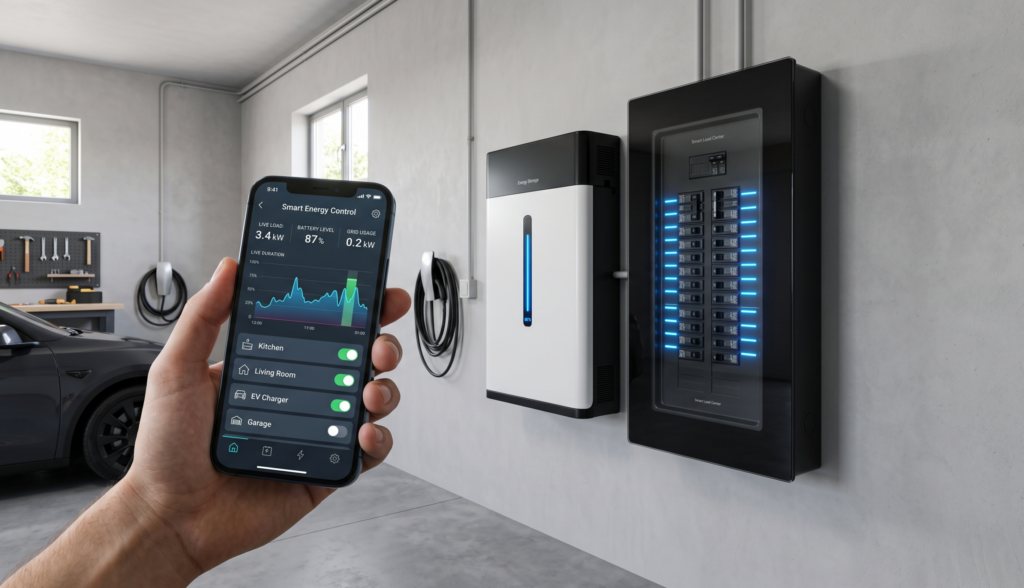
A traditional circuit breaker box is a passive safety device designed to shut off power only when a wire overheats. It has no way to read or report data. A modern intelligent panel replaces these standard switches with digital, internet-connected breakers. This advanced hardware monitors your home’s electrical consumption down to the individual circuit level in real time. It tracks exactly how many watts your kitchen counter, your living room entertainment center, or your water heater draws at any given moment, feeding this data directly into an app on your smartphone.
How Does Automatic Load Shedding Insulate Your Primary Storage Supply?
Load-shedding is the process of instantly cutting off electricity to non-essential appliances to protect your core power supply. When a smart panel detects that your property has disconnected from the main utility grid, it automatically executes a pre-programmed hierarchy of your household circuits. It shuts down secondary breakers—such as the pool pump, the clothes dryer, and vacant guest bedrooms—while keeping power flowing cleanly to your primary appliances. This automated shedding acts as a digital barrier around your backup batteries for your solar system, ensuring not a single watt of stored energy is wasted on non-essential tasks.
Why Does Manual Power Management Fail During An Emergency Outage?
Attempting to manage your home’s electrical load manually during a severe North Texas storm is inefficient and dangerous. If the grid fails during a torrential downpour or a freezing winter ice storm, the last thing you want to do is rush out to a dark garage with a flashlight to flip heavy physical breakers. Furthermore, humans cannot match the split-second timing of software. By the time you wake up, find a light source, and walk to your electrical panel, an unmanaged system may have already drawn thousands of vital watt-hours out of your battery bank, permanently reducing your available backup time.
Stretching Your Battery Infrastructure From Hours To Days | The Math Of Autonomy
Which Home Appliances Are the Most Dangerous Resource Hogs?
Many homeowners do not realize how quickly heavy household appliances can exhaust a fully charged energy storage system. While a laptop or an LED lightbulb draws very little power, any appliance that relies on an electric heating element or a heavy compressor will rapidly deplete your reserves. Running an electric clothes dryer, an electric water heater, or a secondary guest room air conditioner can pull between 3,000 and 5,000 watts of continuous power. Left unmanaged, a single luxury appliance can completely drain a standard residential battery bank in less than three hours.
How Does Energy Triage Preserve Vital Household Power?
Energy triage is the strategic practice of sacrificing high-load comforts to guarantee the survival of your most critical medical and communication tools. By utilizing an intelligent software layout, your home can instantly drop non-essential zones while maintaining uninterrupted power to your refrigerator, your home router, and critical medical devices. The mathematical difference is staggering. A standard refrigerator draws roughly 150 watts when its compressor runs, and a Wi-Fi router uses less than 20 watts. Dropping a single heavy power hog saves enough raw energy to keep your essential appliances running smoothly for days.
What Is The Real World Autonomy Multiplier Effect During Extended Clouds?
The autonomy multiplier effect occurs when intelligent circuit management stretches a modest battery bank to match the performance of a system twice its physical size. If a severe North Texas storm brings consecutive days of heavy cloud cover, your solar panels will produce minimal power. A smart panel calculates your remaining battery capacity and systematically trims lower-priority circuits as the outage drags on. This continuous optimization allows a standard 10kWh or 20kWh battery to easily last through multiple days of grid failure, giving your family true peace of mind without requiring you to purchase excess hardware.
Intelligent Automation In Real Time | Outage Execution
How Does Automated Grid Integration Handle Pre-Storm Preparation?
True storm resilience begins long before the first raindrop hits your roof. Advanced smart panels feature predictive software that constantly monitors local weather forecasts from the National Weather Service. When a severe thunderstorm, tornado watch, or winter freeze alert is issued for the DFW metroplex, the system automatically triggers a specialized storm preservation mode. It overrides any daily economic optimization settings, immediately drawing power from the utility grid to top off your home batteries to 100% capacity, ensuring your property is fully prepared for an imminent blackout.
How Does the System Transition the Millisecond the Utility Grid Fails?
When an equipment failure or fallen tree limb knocks out your utility connection, the smart panel executes its protective rules in less than a fraction of a second. The millisecond the grid goes dark, the intelligent system disconnects your property from the street to prevent dangerous back-feeding. Simultaneously, it instructs the software to drop all pre-selected non-essential breakers. This transition happens so fast that your home’s lights barely flicker, and sensitive electronics like computers and home medical devices remain powered up without resetting.
How Can Homeowners Control and Override Shedding Rules on the Fly?
Automated management does not mean you lose personal control over your property. If an outage lasts for an extended period, you can easily open your smartphone app to view a live map of your home’s power consumption. If you decide you absolutely need to power a specific room or run a small appliance that was automatically shed by the system, you can toggle that specific circuit back on with a single tap. The smart panel will instantly calculate the updated draw and show you exactly how that choice alters your remaining hours of battery backup time.
Building a Future-Proof Foundation | Long-Term Asset Strategy
How Do Smart Panels Simplify Adding Future Energy Equipment Downstream?
Upgrading your home with a smart electrical backbone does more than just protect you during the next severe weather event; it builds a highly adaptive foundation for all future technology upgrades. Traditional electrical panels quickly run out of physical space and electrical capacity when you try to add modern high-load appliances. An intelligent panel acts as an adaptable energy operating system. It allows you to seamlessly integrate an electric vehicle charger, an additional battery bank, or advanced high-efficiency heat pumps downstream without needing a costly, invasive upgrade of your home’s main electrical infrastructure.
Why Does Smart Software Reduce Upfront Battery Hardware Costs?
The traditional response to battery anxiety is simply buying more hardware. If a solar sales representative worries that your battery will not last through a Texas winter storm, they will typically try to sell you a second or third physical battery bank. This brute-force method can easily add ten thousand dollars or more to your upfront project costs. Utilizing a smart panel lets you substitute expensive physical hardware with highly efficient software logic. Maximizing the performance of a single battery through smart load management delivers the same real-world backup duration as a massive system at a fraction of the price.
Why Do You Need a Comprehensive Evaluation for a Resilient Microgrid?
Transitioning your suburban property into an independent, storm-resistant microgrid requires moving past generic product packages. Every home has a distinct electrical footprint based on its age, architectural layout, and appliance types. Securing a complete structural energy evaluation allows you to analyze your home’s precise thermal and electrical performance. This detailed baseline profile ensures that your solar arrays, smart circuits, and energy storage systems are sized perfectly to work together, guaranteeing maximum efficiency and long-term energy independence in Texas.
Securing Your Home Energy Ecosystem
True protection during a Texas grid crisis requires a local partner who understands how to tie advanced technology into a single, cohesive system. Texas Solar Professional was built from the ground up to provide homeowners with absolute energy self-reliance using direct language, fair pricing, and clear, practical engineering. We do not believe in high-pressure sales pitches or relying on outsourced subcontractors. Our dedicated, in-house W-2 installation crews handle every phase of your system design, technical layout, and utility paperwork from start to finish.
As an authorized dealer for advanced SPAN smart electrical panels, we specialize in linking solar arrays, premium inverter backup units, and high-efficiency home mechanics into an intelligent, storm-ready ecosystem. We ensure that your home’s software is fully optimized to protect your family through extended blackouts without forcing you to overpay for unneeded hardware. Our post-installation culture means we stay by your side long after the initial setup is complete, keeping your equipment operating at peak performance for decades to come.
Are you ready to see how an intelligent smart panel can optimize your home storage and deliver absolute peace of mind? Contact Texas Solar Professional today to schedule your free, comprehensive home energy evaluation and estimate.
Frequently Asked Questions
Q. How does an intelligent smart panel know which household appliances to shut off during an outage?
During system installation, you establish a customized priority hierarchy within your smartphone application. The smart panel uses this profile to immediately cut power to non-essential breakers while preserving juice for critical assets.
Q. Can I change my load-shedding rules on my phone while a storm blackout is happening?
Yes. The intelligent panel application allows you to monitor live power data and override any automated rules on the fly, letting you easily redirect battery power to specific circuits as your needs change.
Q. Why is a smart panel a better investment than simply purchasing a second backup battery?
Buying an extra battery adds substantial equipment costs to your project. A smart panel uses intelligent software optimization to double your real-world backup hours on your existing battery, saving you thousands on hardware.