
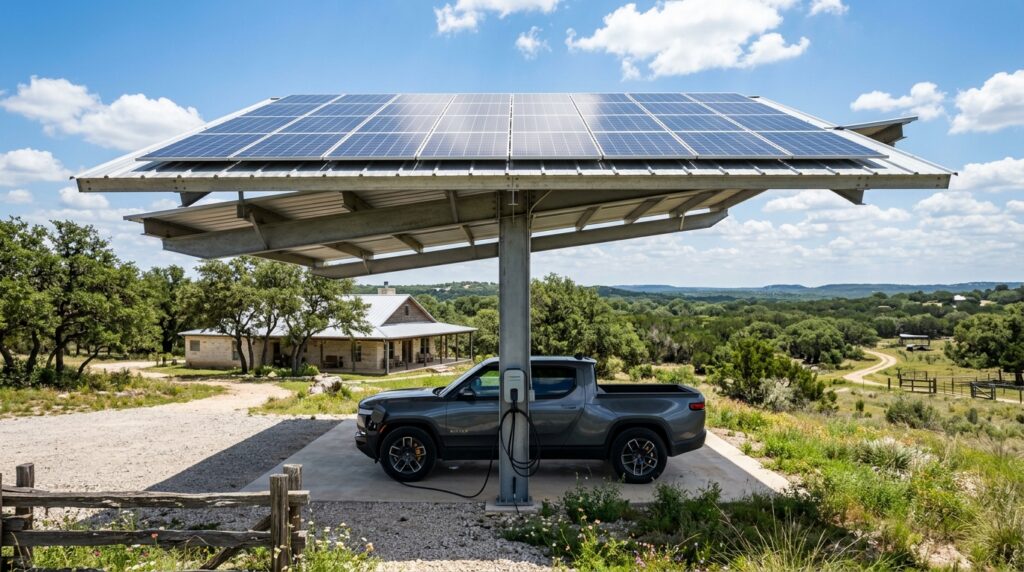
Whether you live on a remote homestead in the Texas Hill Country or own a large spread of land in the Trans-Pecos country, driving across Texas looks a lot different when you’re divorced from the conveniences of basic utilities. If you’re running 100% independent from the ERCOT grid, buying an electric vehicle opens up a whole new can of worms. How can you possibly fuel up your electric car or truck without sacrificing valuable range from your home battery? Will your off-grid solar system even have enough juice to charge an EV?
Yes, it’s entirely possible to charge an EV on an off-grid system. But to do so safely, you need to be precise with your mathematical calculations. Trying to fudge your numbers here will cause you to run out of juice at home. When you size your system perfectly to meet your daily commute, owning an electric car or truck while running off the grid is the pinnacle of energy independence security. Not only will you eliminate your monthly utility bill, but you won’t have to worry about struggling to find a rural gas station ever again.
Breaking Down the Off-Grid EV Charging Math
In order to calculate how to fuel your vehicle with an isolated system, you need to fully understand the difference in power draw between Level 1 and Level 2 charging. A Level 1 charger utilizes a standard 120-volt outlet and uses around 1.4 kilowatts of power on a continuous basis. Although your average backyard inverter can handle this low power draw, charging at this slow rate (3-5 miles of range per hour) is nearly unbearable. Level 2 chargers, on the other hand, utilize a 240-volt circuit and range from 7.6 to 11.5 kilowatts of continuous power.
Your off-grid inverter needs to be able to handle this heavy, constant draw. Regular off-grid inverters aren’t meant to push that kind of high amperage for several hours straight and will likely overheat or trip their circuit breakers repeatedly. You’ll need a heavy-duty hybrid inverter setup (we recommend Sol-Ark or EG4 commercial-grade inverters) that can safely distribute that much power without breaking down.
Once you’ve entered your typical household consumption into the guidelines above, you simply need to account for however many miles you wish to drive your car daily. Adding 50 miles of range to your vehicle could cost you an additional 15 to 18 kWh of power per day — essentially the same as running your home!
Sizing Your Solar Panels and Battery Bank
If you charge your car at night, you could put your off-grid house in jeopardy. Allowing your car to draw that much power without significant overlap will create what we call the “battery drain” problem. Once your car fully saturates your backup batteries for the solar system, there will be nothing left to power your house until the sun rises again. The home always comes first.
- Size Your System for Multi-Day Autonomy: Always build your battery bank large enough to handle several days of heavy cloud cover without forcing you to sacrifice well-pumping duties to charge your EV.
- Install Stable Battery Chemistry: Advanced lithium iron phosphate batteries can handle extreme daily discharges and high power draws without worrying about damage from excessive heat.
- Add More Solar Panels: To guarantee sufficient power for your daily driving needs, you’ll likely need to expand your solar array by another 10-15 high-quality Tier-1 solar panels just to run your car.
Off-Grid EV Charging Best Practices
You wouldn’t risk draining your home batteries on purpose, so why risk it with your vehicle? By installing some extra hardware and forming a few charging habits, you can eliminate this risk and protect your backup batteries for the solar system’s lifespan.
Follow the Solar-Noon Charging Rule
The absolute best time to plug in your car is during the middle of the day when your solar panels are generating excess power. By charging from 10-2, you allow your solar panels to directly feed the car — bypassing your battery bank entirely and giving you the largest possible buffer between nighttime charging and sunrise.
Install a Smart Electrical Panel
Couple your solar with battery storage in a configuration with a smart panel that can actively manage circuit loads based on variables. Automated smart panels can detect sudden changes in solar production caused by weather and pause your car’s charging cycle mid-stream if your battery levels dip below a certain threshold.
Slowly Charge Your Car in Winter
Electric cars come with an in-built mobile application that allows you to set your desired charging speed. Use this to your advantage by lowering your charging speed during the winter months. Slow winter days won’t require you to draw as much power from your panels—simply decrease your charging amperage to match.
Building The Ultimate Off-Grid EV Charging Station
There’s nothing wrong with starting small and expanding your off-grid energy system over time. But if you’re serious about going all-in on your renewable energy transition, you should consider building a dedicated energy hub on your property. Kitchenette setups are fine for hobbyist installations, but large charging loads require serious power to run — loads that your typical residential breaker box just can’t handle.
Linking your solar carport directly to high-amperage circuit wiring housed in its own dedicated structure keeps heavy electricity generation separate from your living spaces. Having a solid shaded structure to house your car under also comes with the added bonus of protecting your vehicle from UV damage.
It’s also crucial to set up some type of automated backup power should your solar production become limited during abnormal weather patterns. We recommend all of our rural customers pair their hybrid inverters with some type of automatic standby generator.
A generator is your last line of defense for winter storms or unplanned weather events that limit your sun exposure for days in a row. During intense cold spells, we always recommend customers keep their automobiles pre-charged, ready to drive at a moment’s notice should their solar generation begin to fall.
At the end of the day, your energy infrastructure is your new home utility company. By building out these complex systems and thinking of your home, battery bank, and car as one collective unit, you can completely eliminate fuel and electricity bills for good. Instead of shelling out tens of thousands of dollars to some big utility over your lifetime, take that money and invest it in building your own microgrid.
Your Off-Grid Experts | Texas Solar Professional
Off-grid solar power is not a one-size-fits-all solution. Specific math is required to ensure your home can reliably support heavy daily transportation needs. At Texas Solar Professional, we specialize in designing tailor-made solar systems with generation, storage, and electric vehicle support built in from the ground up. We do not employ outbound sales teams or pushy door-to-door salesmen. We have three fully staffed W-2 solar installation teams who specialize in end-to-end system buildouts for residential customers. If you’re ready to take back your energy independence in Texas and start powering your vehicle from the sun, contact us today to learn more about how we can help build the perfect off-grid system on your land.
FAQ
Q. Will an off-grid solar system work with an electric vehicle?
- Absolutely! Solar with battery storage in Texas can easily charge an electric car or truck. You just need to make sure you have enough battery storage capacity and solar panels to meet your driving requirements.
Q. Can I trickle charge my EV with an off-grid solar system?
- Yes, all of our hybrid inverters can slow your charging speed down to a trickle. Slowing your charging speed down simply requires fewer solar panels to meet your driving demands and is highly encouraged during the winter months.
Q. Is it better to charge your EV with solar power or grid power?
- Unless you’re paying extremely cheap rates, solar will always beat the grid when it comes to pure cost efficiency. Solar with battery storage in Texas allows you to completely sidestep your electric company and capture 100% of your panels’ feed-in directly for your personal use.
Q. How long does it take to charge an EV with solar panels?
- It all depends on your setup and how many solar panels you have dedicated to running your car. A Level 1 charger can take upwards of 10 hours to fully charge an EV, but a Level 2 Charger can bring that down to 4 hours or less with the proper setup.
Q. Can I charge my EV at night using solar panels?
- Sure, but you’ll need a bigger battery backup system. If you charge your EV at night, you will be pulling power from your home’s battery storage directly. Sizing your battery bank to accommodate nightly charging is easy—it just takes more batteries.