
Many homeowners generalize solar as a quick fix to expensive electric bills they want to cut.
Once they’ve made the choice to go solar, they call solar companies and start planning for installation. This is a great first step, but it overtakes one that many people skip that ends up costing them in the long run.
If your HVAC system is old and inefficient, putting solar on top of it is like adding a bigger faucet to a bucket full of holes. The power you generate just drains right out. At Texas Solar Professional, we always look at the whole home first. Nine times out of ten, an HVAC upgrade changes the entire solar equation. Here’s why.
Why HVAC Efficiency Dictates Your Solar System Size
In most Texas homes, heating and cooling account for 50 to 60 percent of total energy use. That’s not a small number. It means your AC unit is the single biggest factor in how large your solar array needs to be.
A 20-year-old single-stage unit doesn’t just cool your home inefficiently. It forces your solar system to work harder every hour of every day. To compensate for that waste, you might need five to ten additional solar panels just to break even. Panels aren’t free. At current prices, that’s thousands of dollars in extra equipment you wouldn’t have needed with an efficient HVAC system underneath.
There’s a principle worth understanding here: saving a watt is cheaper than generating a watt. Installing a high-efficiency HVAC system typically costs less per unit of savings than adding more solar panels to produce the same amount of energy. Efficiency first is not just a philosophy. It’s math.
Before any HVAC installation in Texas, we pull the home’s utility history and calculate its current load. That number tells us exactly how hard the solar system will have to work. Cut the HVAC load first, and the solar system gets smaller, the battery bank gets smaller, and the overall project cost drops. Everything downstream gets easier.
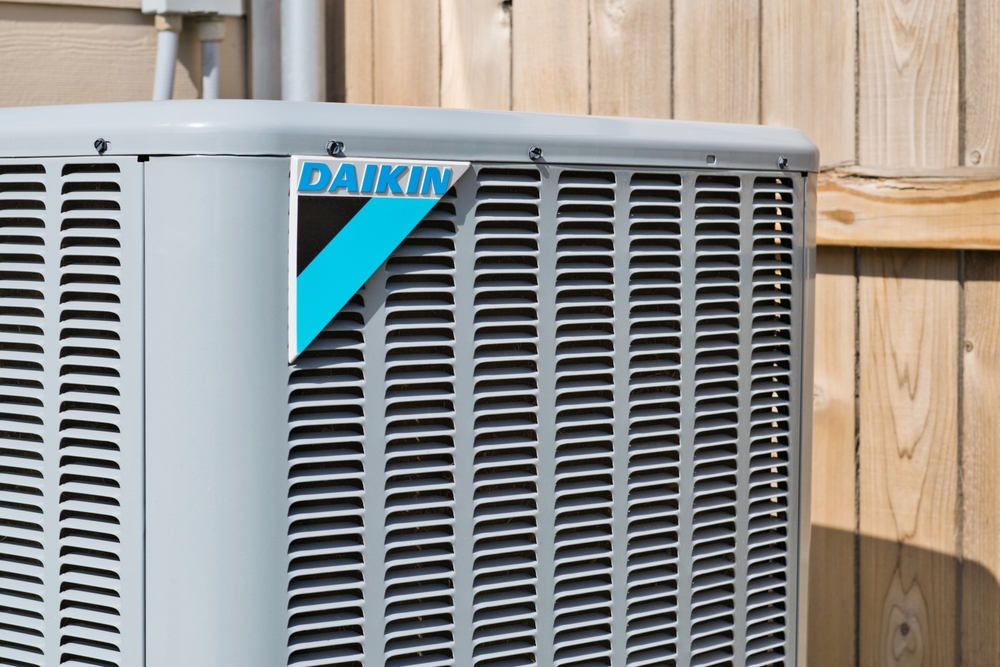
The Daikin Difference: Variable-Speed Technology
Most AC units sold over the past several decades work the same way. The compressor is either on or off. When it kicks on, it runs at 100% capacity until the thermostat is satisfied, then shuts off completely. This “single-stage” approach is simple, but it wastes energy and creates comfort problems.
Inverter technology works differently. A Daikin variable-speed system continuously adjusts its output based on exactly what your home needs at that moment. On a mild spring afternoon, it might run at 30% capacity for hours. On a 105-degree August day in Frisco, it ramps up to meet the demand. It’s always running at the right speed for the conditions, never more and never less.
This has a direct effect on solar and battery compatibility. Single-stage compressors produce a large startup surge every time they cycle on. That surge can be two to three times the unit’s normal running draw. For a battery-backed solar system, those repeated spikes add up. They stress the inverter and pull more energy from storage than the thermostat cycle would suggest.
A Daikin system mostly eliminates that problem. Because the compressor ramps up gradually, the startup surge is far smaller. The system pulls a steady, predictable amount of power. That predictability makes solar system design more precise and battery sizing more accurate.
Comfort is another area where the difference shows up daily. A single-stage unit overshoots and undershoots. It runs hard, drops the temperature past the set point, shuts off, lets the home warm back up, then slams on again. That cycle repeats all day. Humidity control suffers in the process. North Texas summers are brutal partly because of the heat, but also because of the humidity. A variable-speed system runs longer at lower capacity, which gives it more time to pull moisture out of the air. The result is a home that feels cooler at a higher thermostat setting. Less energy used. Same comfort level.
Daikin builds these systems at their manufacturing facility in Waller, Texas, over four million square feet of production and testing. That isn’t a marketing detail. It means the units are tested against actual Texas conditions. They’re built here. They’re built for here.
One more thing worth mentioning: noise. A single-stage unit blasting on at full power is loud. You can hear it from inside the house. A Daikin variable-speed system running at partial load is nearly silent. That’s a daily quality-of-life difference that homeowners notice fast.
Long-Term Benefits: ROI, Warranties, and Resilience
An HVAC replacement in Texas is a significant investment. It helps to understand what you’re actually getting for the money.
A standard builder-grade AC unit carries a 5 to 10-year warranty and is typically built to last 12 to 15 years, sometimes less in Texas where it runs nearly year-round. Daikin units installed by a certified dealer come with a 12-year parts and labor warranty. That’s real protection on a piece of equipment that runs every single day.
On energy savings, real-world results vary by home, but upgrading from an older single-stage unit to a high-efficiency variable-speed system commonly cuts HVAC-related energy use by 25 to 40 percent. For a DFW home paying $250 to $350 per month in summer electricity, that’s a meaningful reduction. Over ten years, those savings add up to the kind of number that makes the upfront investment look very reasonable.
Working with a certified Daikin dealer near you also matters for solar compatibility. Daikin HVAC systems in Texas need to be sized and installed correctly to perform as rated. A variable-speed system sized properly works well with solar inverters and smart panels. The installation has to be done right for the system to deliver what it promises. As certified Daikin dealers, we’ve been trained specifically on this equipment, and we install it with solar-ready homes in mind.
The “Whole Home” Strategy: Planning Your Upgrade Path
The most cost-effective approach is to plan your energy upgrades together, not one at a time.
Start with an energy audit before any HVAC installation in Texas. An audit tells you how much energy your home currently uses, where it’s being wasted, and what your actual heating and cooling load looks like after accounting for insulation, windows, and air sealing. That data drives every decision that follows. It determines the right size for your HVAC system, which then drives the right size for your solar array, which drives how much battery storage you actually need.
Tax incentives make a strong case for bundling upgrades. Under current federal guidelines, certain efficiency improvements and solar installations may qualify for tax credits. Combining an HVAC upgrade and a solar installation in the same tax year can allow a DFW homeowner to take advantage of multiple incentives at once. Tax rules change, so talking with a tax professional about your specific situation is always smart. But the timing question is worth asking early.
The numbers from DFW projects tell a consistent story. A home that upgrades to a Daikin variable-speed system before going solar typically needs 25 to 35 percent fewer solar panels than it would have with the old system still in place. One recent project in the Dallas area was originally scoped for 14 panels. After the HVAC upgrade, the solar design came in at 9 panels. Same coverage. Lower total cost. Better long-term performance.
That’s efficiency-first in action. Smaller system. Lower upfront cost. Faster payback. The HVAC upgrade effectively pays for part of itself through the solar savings it unlocks.
What This Looks Like for a Real DFW Home
Picture a home in Plano with a 15-year-old single-stage AC unit. It cycles hard all summer, runs constantly in July and August, and costs around $310 a month to cool. The homeowner wants solar.
Option A: Solar goes on without touching the HVAC. The system is sized around the existing load. It needs 16 panels and a full battery bank to cover peak summer demand. After incentives, the project runs around $35,000.
Option B: HVAC upgrade first, then solar. The new Daikin variable-speed system cuts the cooling load by roughly 30 percent. The home now needs 10 panels and a smaller battery. Solar installation comes in around $22,000 after incentives. The HVAC upgrade cost $9,000. Total outlay: $31,000. Less money spent overall, better system performance, and a noticeably more comfortable home all year.
The sequence matters. And the savings are real.
Experience High-Efficiency HVAC With Texas Solar Professional
Going solar is a smart move for Texas homeowners. Done in the right order, it’s an even smarter one.
High-efficiency HVAC is the foundation. Without it, you’re building a solar project on top of a waste problem. With it, everything gets smaller and more affordable: the panel count, the battery size, the total project cost, and the payback timeline.
Texas Solar Professional handles both sides. We’re licensed for HVAC installation in Texas and certified Daikin dealers. We design and install solar. We look at every home as a single energy system, not a list of products. If you’re thinking about solar for your Texas home, we’re ready to have the important conversations. Reach out, and we’ll set up your energy audit.